Short answer: The main difference between a full-electric and an electro-hydraulic hybrid injection blow molding machine is how the machine drives and controls its movements. LIANXIN's IBM-E series uses servo motors for critical motions and an EtherCAT-based electrical control system. The IBM-H series combines an electro-hydraulic system with servo-driven indexing and hydraulic clamping components.
Neither design is automatically better for every project. The right choice depends on the bottle, mold, material, required production capacity, operating environment, and the customer's preferred drive and maintenance system.
Key Differences at a Glance
| Area | Full-Electric IBM-E | Hybrid IBM-H |
|---|---|---|
| Drive architecture | Full-electric servo system | Electro-hydraulic hybrid system |
| Control system | EtherCAT-based electrical system with a Techmation controller | Hydraulic operation supported by servo-driven indexing and CNC control |
| Critical movements | Rotation, ejection, and flipping use servo motors | Indexing uses a servo drive for fast, quiet, and stable rotation |
| Mold movement | Servo ball screw drive for mold opening and closing | Bottom-mounted clamping cylinder and dual-cylinder clamping |
| Energy claim | Up to 70% lower energy consumption according to LIANXIN product data | Up to 40% energy savings according to LIANXIN product data |
Important: The percentages above are manufacturer product-data claims, not guaranteed results for every production line. Actual energy consumption varies with the bottle, resin, mold, cycle settings, auxiliary equipment, production load, and operating conditions.
For a comparable energy review, use a defined duty cycle and measure the complete drive system at representative speed, torque and load points. IEC 61800-9-2:2023 defines efficiency classes and loss-testing methods for power drive systems, while the European Commission motor guidance explains that variable-speed-drive savings depend on the application and changing load. These independent sources support the measurement method, not LIANXIN's 70% or 40% product-data claims.
How the Full-Electric IBM-E System Is Configured
LIANXIN's IBM-E product information describes an EtherCAT-based electrical operating system with a Techmation controller. This system is designed for fast communication and precise motion control.
Do not treat a control-network name as proof of machine performance. Confirm command-cycle timing, synchronization, alarm handling and recovery during the factory acceptance test under the agreed mold, recipe and auxiliary load; distinguish those measured results from protocol-level specifications.
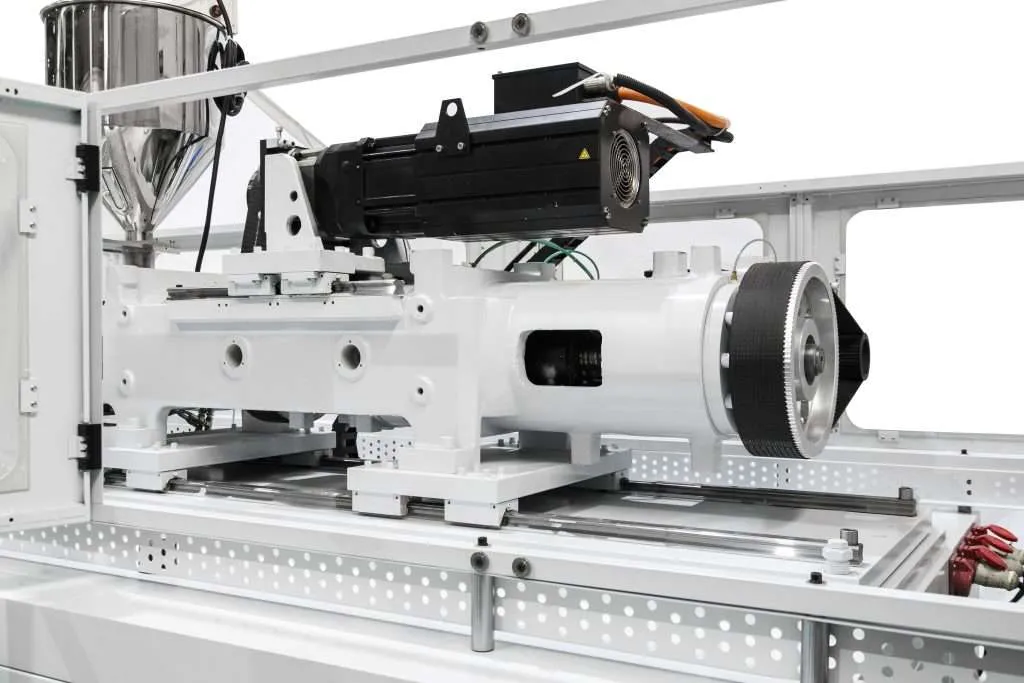
Critical functions—including rotation, ejection, and flipping—use servo motors. Mold opening and closing are driven by a high-precision Japanese servo ball screw system, which the product material describes as rapid, low-impact, and quiet.
The clamping structure uses a double-beam, four-tie-bar toggle design intended to distribute clamping force reliably. For injection and plasticizing control, the IBM-E design includes CNC-controlled back-pressure regulation, a motion-control module, and a high-resolution digital encoder.
IBM-E characteristics highlighted in the product data
- Servo control for multiple critical machine movements
- EtherCAT-based electrical communication and control
- Servo ball screw mold opening and closing
- Double-beam, four-tie-bar toggle clamping
- CNC-controlled back pressure for consistent plasticizing
- Quiet and low-impact movement as described by LIANXIN
How the Hybrid IBM-H System Is Configured
The IBM-H series combines hydraulic mechanisms with selected servo-controlled movements. Its servo-driven indexing system is designed to provide fast, quiet, and vibration-free rotation while retaining an electro-hydraulic machine architecture.
A bottom-mounted clamping cylinder is used to save space, support smooth mold rotation, and reduce the risk of contamination from oil leakage. The dual-cylinder clamping design is intended to provide balanced force and stable operating cycles.
Like the IBM-E description, the IBM-H product information also identifies CNC-controlled melt back pressure as a way to support reliable and consistent plasticizing.
IBM-H characteristics highlighted in the product data
- Electro-hydraulic hybrid drive architecture
- Servo-driven indexing
- Bottom-mounted clamping cylinder
- Dual-cylinder clamping for balanced force
- CNC-controlled melt back pressure
- Design positioned for stable, quiet operation
How to Choose Between Full-Electric and Hybrid
Consider the IBM-E series when your project prioritizes extensive electrical motion control, servo-driven mold movement, and precise coordination of critical actions. Consider the IBM-H series when you prefer an electro-hydraulic structure combined with servo indexing and balanced hydraulic clamping.
Do not select a machine only from a headline energy-saving percentage. Before making a decision, provide the supplier with your bottle samples or drawings, resin, mold requirements, expected output, and production environment. Request a machine and mold proposal based on the real application.
LIANXIN's product descriptions identify both machine families as compliant with European safety requirements. Buyers should still confirm the documentation and certification supplied with the exact model included in their order.
Frequently Asked Questions
Is a full-electric injection blow molding machine always more energy-efficient?
Not necessarily under every operating condition. According to LIANXIN product data, the IBM-E series can reduce energy consumption by up to 70%, while the IBM-H series can provide savings of up to 40%. Actual results vary with the production process, mold, material, settings, auxiliaries, and workload.
Do hybrid injection blow molding machines use servo motors?
Yes. The IBM-H product data specifies servo-driven indexing. “Hybrid” means the machine combines electrical servo control with hydraulic mechanisms; it does not mean that all movements are purely hydraulic.
Do the two machine types use the same clamping structure?
No. The IBM-E information describes a double-beam, four-tie-bar toggle clamping system and servo-driven mold movement. The IBM-H information describes a bottom-mounted clamping cylinder and dual-cylinder clamping.
Which machine is suitable for my bottle?
That decision requires application-specific information. Bottle geometry, material, mold design, production target, and factory conditions should be reviewed together. A sample-based technical evaluation is more reliable than choosing solely by machine category.
Should quoted energy savings be accepted without a test condition?
No. Define the bottle, resin, mold, cycle, accepted output, auxiliary equipment, duty cycle and measurement boundary. Compare the complete line at a representative load instead of comparing isolated headline percentages.
Authoritative Technical References
- IEC 61800-9-2:2023: energy efficiency of power drive systems
- European Commission: electric motors and variable-speed drives
Conclusion
The IBM-E and IBM-H families approach injection blow molding from different drive architectures. Review the IBM-E full-electric range and IBM-H hybrid range, then compare the actual configuration against your bottle and production requirements. To define a representative test condition, send the bottle, resin, mold and output brief.