Short answer: One-step injection stretch blow molding combines preform injection, temperature conditioning, axial stretching, blow expansion and ejection in one integrated cycle. It can produce clear, seamless-base containers, but bottle geometry, resin, mold design and measurable sample criteria still determine whether the process fits a project.
The central idea is continuity. A preform is created, stretched, expanded into its final shape and then released as a finished container through a coordinated sequence. However, “one-step” does not mean that every container can use the same settings. Material choice, neck finish, bottle geometry, mold design and required output still have to be reviewed for each project.
The UNIDO Plastics in Packaging publication illustrates one-step stretch injection blow molding as preform molding, temperature conditioning, axial stretching and radial blow expansion before ejection. This supports the generic process sequence; LIANXIN's flash-free, scrap-free and seamless-base statements remain manufacturer claims to verify with project samples.
For U.S. food-contact applications, 21 CFR 177.1630 sets identity, specification and extractives conditions for polyethylene phthalate polymers. Compliance remains specific to the resin grade, additives and intended conditions of use.
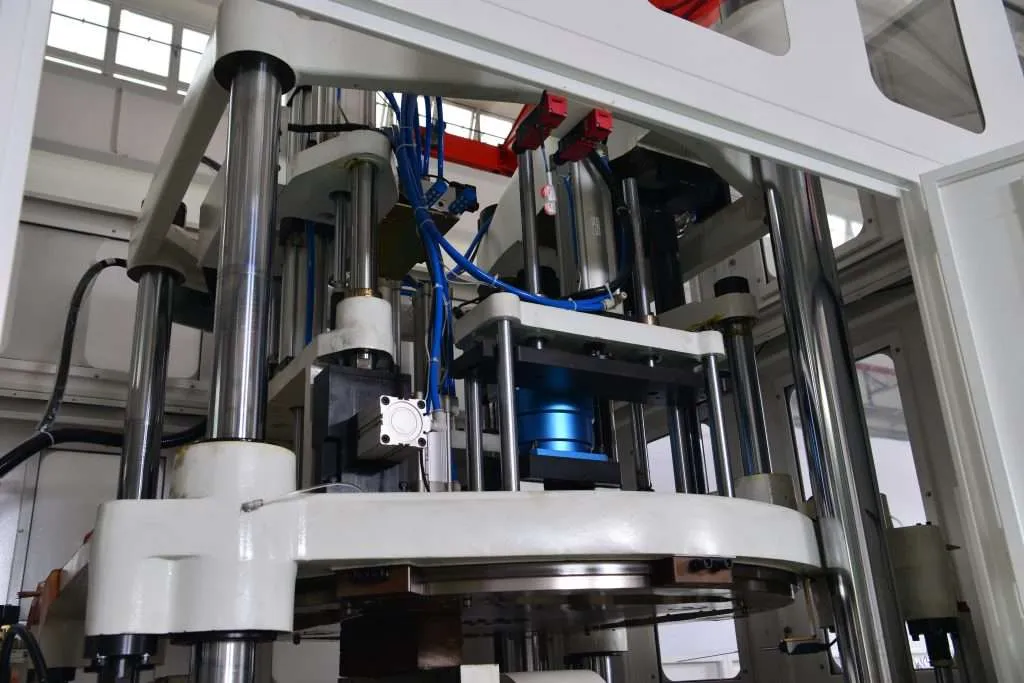
The Four Stages of the One-Step ISBM Cycle
1. Injection and preform formation
The cycle begins by injection molding a preform. A preform is an intermediate shape rather than the finished bottle or container. It establishes the neck area and the initial distribution of material that will be stretched and blown during the following stages.
This first stage matters because the preform must support everything that follows. Its geometry has to correspond with the intended neck finish, body shape, base design and mold solution. Those requirements should therefore be defined before equipment and tooling are finalized. A successful project starts with the finished container specification and works backward to the required preform and forming process.
2. Stretching the preform
After injection, the preform is stretched in the lengthwise direction. During the complete stretch-and-blow operation, the material is oriented in two directions: along the container and around its circumference. This is known as biaxial stretching.
The supplied product information identifies more even wall thickness as an important advantage of biaxial stretching compared with non-stretched blow molding. In practical project planning, the required wall distribution should be evaluated across the shoulder, body and base rather than judged only by the container's average weight. The exact stretching conditions are application-specific and should be confirmed through tooling review and sample evaluation.
3. Blowing the final container shape
During the blowing stage, the stretched preform expands into the mold and takes on the final container geometry. The mold defines the body profile, surface form and base shape. The published overview associates the integrated process with excellent transparency, making optical appearance an important inspection point for projects that require a clear finished container.
The same overview describes the intended output as flash-free and scrap-free, with a seamless base. In this context, flash-free means the forming process is designed to avoid unwanted excess material around the finished part, while a seamless base provides a clean, continuous base appearance. These qualities can reduce the need for post-forming cleanup, but they should still be verified with approved samples and clearly defined acceptance criteria.
4. Ejection and cycle completion
Once forming is complete, the finished container is ejected and the integrated cycle continues. Ejection is not a separate afterthought: it is one of the four coordinated operations included in the one-step process.
Reliable release is important because a container must leave the tooling without compromising its neck, body, base or appearance. The ejected sample should therefore be checked against the agreed drawing and quality standard before a project moves into routine production.
What “Flash-Free” and “Scrap-Free” Should Mean in a Project
These terms describe the intended forming output of the one-step process. They should not be interpreted as a guarantee that an entire factory will never produce a rejected container. Startup, tooling condition, process control and quality requirements can all affect actual results. The best approach is to define measurable acceptance criteria for flash, wall distribution, base appearance, transparency and critical dimensions, then approve physical samples against those criteria.
When Should You Consider One-Step ISBM?
One-step injection stretch blow molding is worth evaluating when a project values an integrated production sequence together with clear appearance, seamless bases, controlled wall distribution and flash-free forming. It can be especially relevant when the neck finish and final container must be developed as one coordinated mold and process solution.
Machine selection should not be based on a model name alone. The forming process, selected material, container capacity, neck size, body shape, required output, application and mold solution all affect whether a particular configuration is suitable.
How to Validate a One-Step ISBM Proposal
Use a controlled trial with the intended resin, bottle drawing and closure interface. Record wall-thickness distribution, neck and body dimensions, capacity, weight, transparency, base appearance, leakage, cycle and good-container output. A machine description or process name does not replace agreed sample limits.
Review the LIANXIN ISBM platform only after the bottle and acceptance criteria are defined. For an engineering review, send the drawing, resin, neck, target output and reference samples.
Project Preparation Checklist
- Finished container drawing: Provide overall dimensions, neck finish, body profile, base geometry and critical tolerances.
- Material requirement: Identify the intended material and any appearance, handling or compliance requirements that must be confirmed.
- Quality standard: Define acceptable wall distribution, transparency, flash, base appearance and dimensional consistency.
- Reference samples: Supply an existing bottle or visual reference when possible, especially for unusual shapes or surface expectations.
- Production objective: State the required output and downstream steps without assuming a model-specific capacity before technical review.
- Mold and testing plan: Agree on the tooling concept, sample approval process and checks required before production acceptance.
- Site requirements: Confirm utilities, installation space and supporting equipment with the machine supplier for the selected configuration.
Authoritative Technical References
- UNIDO: Plastics in Packaging — One-Step Stretch Injection Blow Molding
- Electronic Code of Federal Regulations: 21 CFR 177.1630 Polyethylene Phthalate Polymers
Frequently Asked Questions
What makes injection stretch blow molding a one-step process?
Preform injection, stretching, blowing and ejection are integrated into one continuous production cycle rather than treated as unrelated forming operations.
How does stretching affect the finished container?
The published LIANXIN overview states that biaxial stretching provides more even wall thickness than non-stretched blow molding. Final wall distribution still depends on the approved container, preform and mold solution.
Does scrap-free mean there can never be rejected parts?
No. Scrap-free describes the intended forming output. Actual rejection levels can be influenced by startup, process control, tooling condition and the project's quality limits.
What information is needed before selecting a machine?
Prepare the container drawing, material, capacity, neck size, shape, required output, application and mold requirements. These inputs allow the supplier to evaluate the process and configuration without relying on unsupported assumptions.
Does one-step mean the preform needs no temperature control?
No. The integrated cycle still requires controlled temperature conditioning so the preform can stretch and blow into the intended wall distribution and appearance.
One-step ISBM is easiest to evaluate when the project begins with a clearly defined finished container. With the drawing, quality targets, material requirement and samples in place, injection, stretching, blowing and ejection can be developed as one coordinated production solution.