Injection blow molding is usually the stronger fit for small containers that need an accurately molded neck and little or no trimming; extrusion blow molding is often favored for handled, offset-neck or larger hollow parts. The best process follows the package geometry and quality target, so compare the two from the neck, body and production economics outward.
Process Difference in One Minute
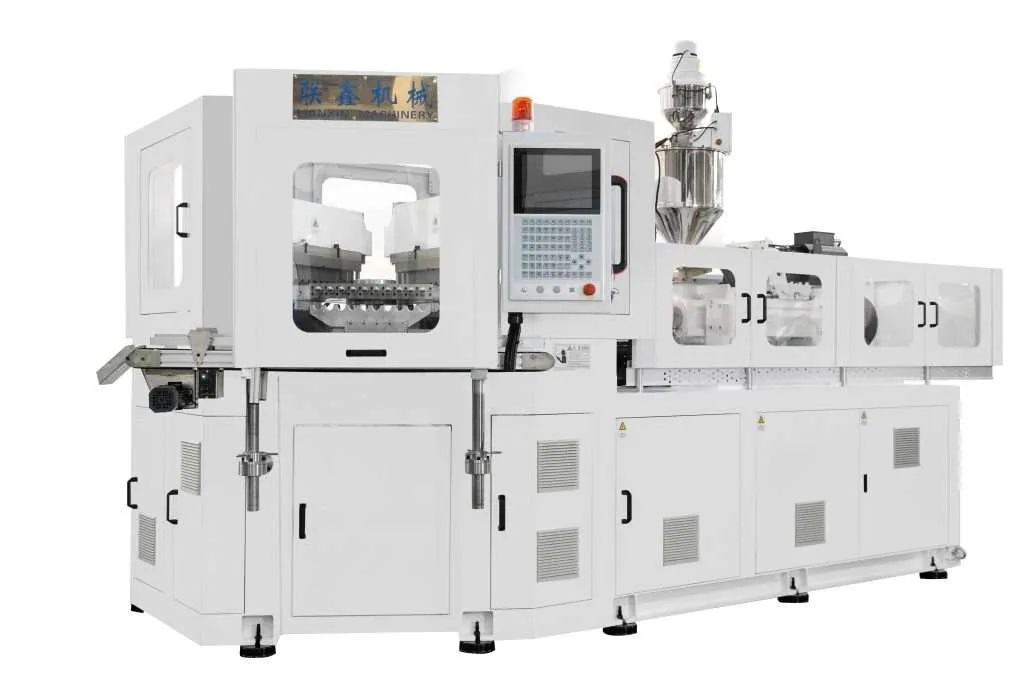
In injection blow molding, molten polymer is injected around a core rod to form a preform with a finished neck. The core rod transfers that preform to a blow mold, compressed air expands the body, and the cooled bottle is ejected. The UNIDO Plastics in Packaging technical report describes these three IBM stages, the core-rod transfer and the close-tolerance neck formed during injection.
In extrusion blow molding, an extruder pushes a hollow tube of polymer called a parison. The same UNIDO report explains that the mold closes around and pinches one end of the extruded parison before blowing. In a conventional EBM tooling design, the resulting pinch-off material is therefore a trimming and scrap consideration to verify for the selected bottle and mold.
Key Differences at a Glance
| Factor | Injection blow molding | Extrusion blow molding |
|---|---|---|
| Neck finish | Injection molded on the core rod for controlled detail | Formed around the parison and mold tooling |
| Flash | Finished bottles are normally produced without body pinch-off flash | Pinch-off flash is a normal process consideration |
| Typical geometry | Narrow- or wide-mouth bottles and jars with a defined neck | Broader freedom for handles, offset necks and larger hollow parts |
| Wall control | Preform design and temperature strongly influence distribution | Parison programming can vary wall thickness along the drop |
| Tooling | Injection mold, blow mold, neck tooling and core rods | Extrusion die, blow mold and trimming system |
When Injection Blow Molding Has the Advantage
IBM is attractive when the package needs repeatable threads, sealing surfaces or tamper-evident features at the neck. Because the preform neck is injection molded and carried through the blow stage, the body can expand while the finish remains controlled. The absence of normal pinch-off scrap also simplifies the material flow for many small-bottle projects.
Common applications include pharmaceutical bottles, eye-drop containers, cosmetic bottles, roll-on packs, food containers and chemical sample bottles. LIANXIN source material covers PE, HDPE, LDPE, PP and PS bottle projects from 2 mL to 1,200 mL across its broader machine range; every specific bottle still requires a machine-and-mold review.
When Extrusion Blow Molding Has the Advantage
EBM is commonly selected when the design includes an integral handle, a strongly offset neck, a very large body or geometry that benefits from a hanging parison. Its tooling can be comparatively direct for many large containers, although trimming, flash handling and parison control must be included in the line concept.
The process should not be chosen on bottle volume alone. A small handled container may suit EBM, while a larger straight-neck bottle with demanding finish accuracy may still justify an IBM feasibility study. Geometry, resin and acceptance criteria decide.
Quality and Cost Questions to Compare
- Does the neck need molded threads or a controlled sealing surface?
- Can the package tolerate pinch-off lines and a trimming operation?
- Is an integral handle or offset neck essential?
- How much resin becomes flash, start-up scrap or rejected product?
- What cavity count and cycle are realistic for the bottle weight?
- Which leak, dimensional, visual and top-load tests define an accepted bottle?
Energy should be compared at the line level. IEC 61800-9-2:2023 provides efficiency classes and loss-testing methods for power drive systems, but a bottle line also includes cooling, compressed air and auxiliaries. Request measured consumption under a defined production condition instead of relying only on a drive label.
OSHA's plastics-industry page separately lists ANSI/SPI B151.21 for IBM and ISBM machinery and B151.15 for extrusion blow molding machinery as national-consensus safety standards. OSHA also states that the standards on that page are not OSHA regulations, so use the page for safety-scope planning rather than as process-performance evidence.
A Practical Process-Selection Rule
Choose IBM when the neck is the dominant precision feature and the bottle body fits a core-rod transfer process. Choose EBM when body geometry, handles or size favor a free parison and the project can manage flash and trimming. If the answer is unclear, ask both process suppliers to review the same drawing, resin and quality specification.
LIANXIN specializes in injection blow and injection stretch blow equipment. To test IBM feasibility, send the bottle drawing, resin and output target rather than a generic request for machine price.
Frequently Asked Questions
Does injection blow molding produce flash?
The process normally produces a finished body without the pinch-off flash associated with extrusion blow molding, although start-up and rejected material still have to be controlled.
Which process gives a more accurate bottle neck?
Injection blow molding is commonly chosen for controlled neck finishes because the neck is injection molded as part of the preform.
Can injection blow molding make handled bottles?
Integral handles are generally a stronger extrusion blow molding use case. A specific design should be reviewed before the process is selected.
Is extrusion blow molding always cheaper?
No. Tooling, trimming, material loss, cycle, cavities, labor and quality yield all affect total cost. Compare complete production cases.
Can the same resin run in both processes?
Some resin families can be used in both, but the commercial grade and rheology must suit the selected process and finished-package requirements.