Before ordering an injection blow mold, freeze the bottle requirements that drive the preform, core rod, neck tooling and blow cavity. The ten questions below turn a visual bottle concept into an engineering brief and expose the interface risks that otherwise appear during sampling or production.
1. Is the Bottle Drawing Complete?
Use a controlled 2D drawing and, where helpful, a 3D model. Include overall dimensions, nominal and brimful volume, neck finish, critical radii, label panel, base, tolerances and datum scheme. Mark which values are functional and which are cosmetic.
A sample bottle is useful, but it is not a drawing. Measurements from a used or filled sample may include shrinkage, distortion and unknown manufacturing tolerances.
2. Which Neck and Closure Standard Applies?
The neck is formed during injection and normally remains dimensionally defined through blowing. Provide the closure drawing, thread or snap geometry, seal contact, torque or insertion targets and tamper-evident interface. For pharmaceutical projects, the FDA container-closure guidance treats the bottle, closure and related components as one packaging system that must be shown suitable for its intended use; it does not prescribe a universal neck finish.
3. What Exact Resin Grade Will Run?
Resin affects shrinkage, melt flow, cooling, wall distribution and ejection. State the supplier and grade plus pigment, additives and permitted regrind policy. If two resins must run in one mold, identify both before the design is approved and accept that process windows may differ.
4. How Should the Preform Distribute Material?
The preform is not a simple miniature bottle. Its length, thickness and temperature profile determine how material stretches into the shoulder, body and base. Heavy corners or a wide shoulder may need a different distribution from a straight cylindrical bottle.
Review simulation or engineering calculations where the project risk justifies them, then verify with sampled wall-thickness data. Do not correct every thin area by adding overall bottle weight.
5. What Must the Core Rod Control?
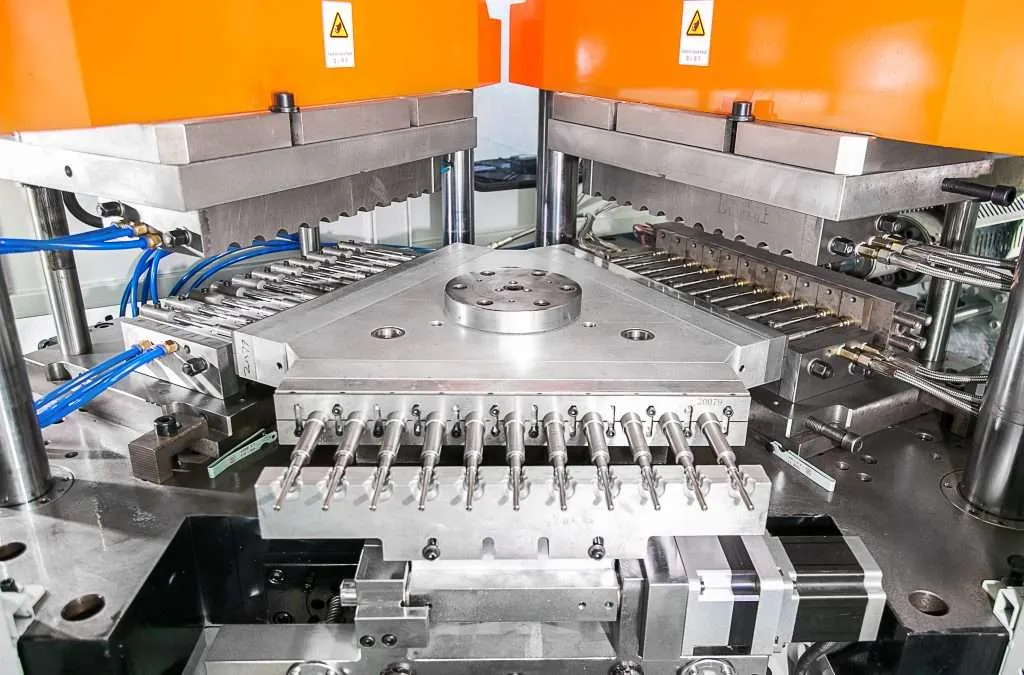
The core rod carries the preform between stages and provides the blow-air path. The UNIDO Plastics in Packaging report describes the preform being transferred on the core rod, blow air passing through it, and the finished neck being molded to close tolerances during the injection stage. This supports those basic process functions, not a universal core-rod design.
For the purchase specification, define core-rod and neck-tooling geometry, transfer alignment, air routing, cooling or temperature-control strategy, seals, inspection method, service access and matched-spare requirements with the machine and mold suppliers.
6. How Many Cavities Are Economical?
Cavity count depends on bottle size, neck spacing, machine platen and indexing geometry, shot capacity, cooling, target output and mold cost. More cavities do not guarantee lower cost if cycle stability, maintenance or reject rate deteriorates.
Require an output calculation that states cycle, cavities and expected good-bottle yield. Confirm the machine has practical plasticizing and clamp margin for the complete mold.
7. How Will Cooling Be Balanced?
Map cooling circuits for the injection mold, core rods and blow mold. Uneven cooling can produce dimensional drift, sticking, haze, warped bases or long cycles. Specify water quality, supply temperature, pressure and flow assumptions so the mold trial represents the future factory.
8. Which Bottle Tests Will Approve the Tool?
| Requirement | Approval evidence |
|---|---|
| Neck and body dimensions | Defined gauges, conditioning time and sample size |
| Capacity and weight | Written method and statistical summary |
| Leakage | Pressure or vacuum method with pass limit |
| Wall distribution | Named measurement locations and minimums |
| Appearance | Approved boundary samples and lighting conditions |
| Closure fit | Functional assembly and seal test |
Distinguish dimensional approval from filled-package validation. Tool acceptance proves the mold can make the agreed bottle; it does not prove long-term compatibility with the product.
9. How Will the Mold Change Over and Be Maintained?
Check lifting points, storage stands, connections, alignment features, access to wear parts and the safe changeover sequence. Where mold changes expose workers to unexpected startup or stored electrical, mechanical, hydraulic, pneumatic or thermal energy, follow the site-specific energy-control procedure and applicable law; OSHA's hazardous-energy guidance explains the U.S. lockout/tagout requirements. Standardize water, air and electrical connections where the plant already has a convention, and request preventive-maintenance and spare-component lists.
10. Who Owns the Data and Future Changes?
Clarify ownership of bottle drawings, mold design, electrode or insert data, process recipes and inspection fixtures. Define approval authority, revision control, confidentiality and how replacement parts will be ordered. Record the final as-built condition after sampling changes.
LIANXIN can coordinate machine and cooperative mold evaluation when it receives the bottle, resin, neck and output requirement. Send the tooling brief for review before issuing a purchase order.
Frequently Asked Questions
Does the injection blow mold include more than one mold?
The system normally includes preform or injection tooling, neck tooling, core rods and a blow mold, with ejection interfaces. Confirm the supplier's exact scope.
Why is the neck drawing so important?
The neck is formed during injection and must fit the closure and seal. Late neck changes can affect several tooling components.
How is cavity count selected?
It is selected from bottle dimensions, machine envelope, shot and clamp capability, cooling, cycle target, output and tooling economics.
Can bottle weight be reduced after the mold is built?
Some process and preform changes may be possible, but large reductions can require tooling changes. Establish wall-distribution and performance targets early.
Should the machine and mold come from the same supplier?
They do not have to, but one party must own interface coordination. Shared drawings, review gates and acceptance criteria are essential.